Getting Started
Have you ever found yourself lying awake the night before something important, rehearsing every possible way it could go wrong?
Maybe it’s a difficult conversation, a job interview, a presentation, or a performance. Whatever the challenge, you’re emotionally invested in the outcome. And the more you care, the easier it is to get stuck in your head.
It’s a frustrating bind. You know that if you can’t stop obsessing over what might happen, you’re going to bring exactly the kind of distracted energy into the situation that will make your worries come true.
How do we even get started when anxiety and uncertainty threaten to paralyze us?
Very recently, I found myself in just this situation. I was about to teach an unusually large yoga class that included many fellow yoga teachers, several of whom had trained me as an instructor. What’s more, this was no ordinary class—it was the first I was teaching to the students and staff of OYC as an incoming new owner.
My nervous energy must have been palpable because several people approached me before class and commented that I looked anxious. And they were right.
There were a lot of expectations in the room, at least in my mind. Would I live up to them? What if I got tongue-tied? What if the class was a disaster?
Fortunately, this was a challenge I was facing on the yoga mat, and getting out of our heads is exactly what yoga is designed to address—citta vritti nirodhah: the stilling of the fluctuations of the mind.
But before we look at what the mat teaches us about this, let’s consider some of the more obvious solutions.
The first is simply trying not to think about what’s worrying you. Unfortunately, anyone who has tried to stop a thought knows what usually happens: the effort to suppress it brings it back even more forcefully.
Well, if we can’t stop the thought, perhaps we can replace it with better ones. Positive self-talk certainly has its place, especially when our fears are exaggerated or unfounded. Unfortunately, not all of our fears are actually irrational.
In the Bhagavad Gita, Arjuna is paralyzed by doubt before a battle because he knows people he loves may die. Krishna does not tell him that everything will work out or that his fears are misplaced. Instead, he offers a different teaching:
“You have the right to perform your prescribed duties, but you are not entitled to the fruits of your actions.”
It’s a stark message: get out of your head and into the task at hand—not because your worries are wrong, but because worrying about them won’t help.
So we return to the question: how do we focus on the action before us when anxiety has taken hold and we’re in our heads?
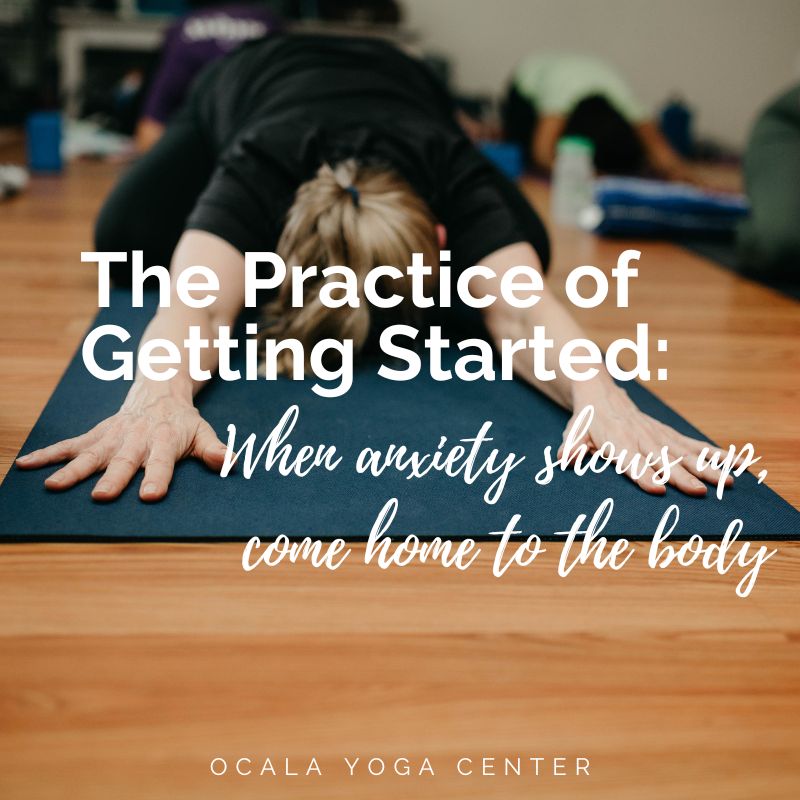
In my case, I was already on a mat, in a studio. So I did some yoga.
We got centered. We got into our bodies. I brought my attention into the strong sensations I was experiencing. Rather than resisting the anxious energy, I leaned into those sensations and embraced them. Almost immediately my attention shifted from worrying about the class to teaching the class. Now, whether the class was any good, I’ll leave for the students to decide. But I felt fully present for it.
For those who have taken my classes before, this will sound familiar: we learn on the mat that the mind will always try to distract us from intense sensation and discomfort—whether physical or emotional. When we notice that happening, the first step is to pat ourselves on the back for having noticed. But then we return all of our attention to the sensations in the body that the mind is trying to distract us from.
Beneath anxious thoughts is a movement of energy in the body that we are resisting. When we turn toward that sensation instead of away from it—when we allow it, feel it, and let it move—the paralyzing thoughts lose their grip on our attention and start to fade from our awareness.
The mat doesn’t teach us how to eliminate uncertainty or avoid the sensations that arise from it. It teaches us how to meet that energy and welcome it.
Are you ready to get started?
Jai Bhagwan,
Jesse