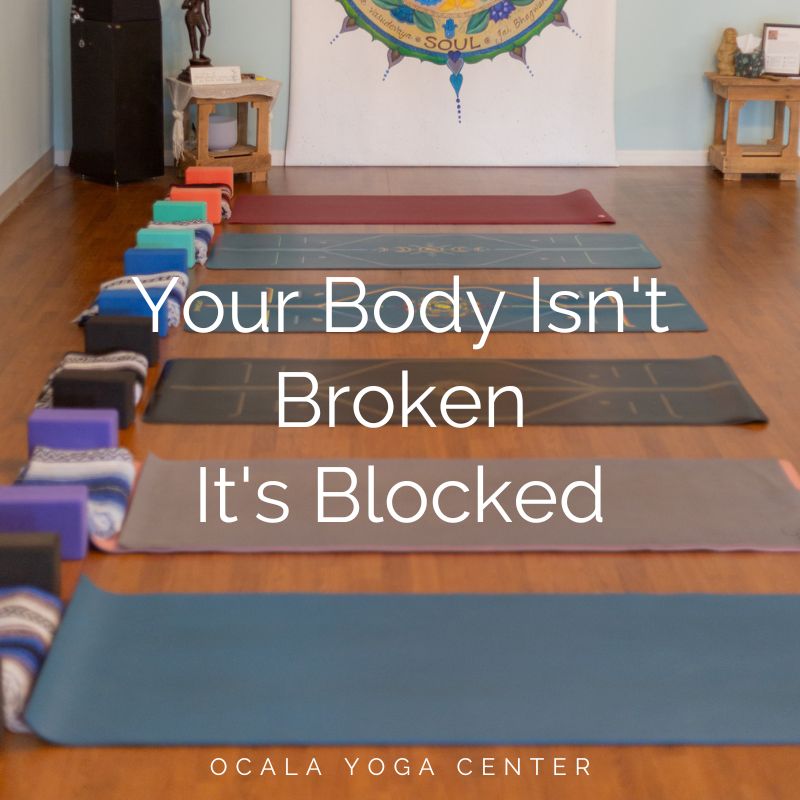
Your Body Isn’t Broken. It’s Blocked.
A fellow yoga teacher recently shared a Big Think article that raises a question that warrants consideration:
What if your health isn’t primarily driven by your genes, your diet, or even exercise, but by how energy moves through your body?
The article cites research suggesting the body functions less like a collection of parts and more like a dynamic system, in which flow, regulation, and communication determine whether you tip toward health or dysfunction.
Groundbreaking, right? For Western science, absolutely! I’m genuinely enthused that this is being studied. And, yoga has been saying this for several thousand years!
First, Let’s Talk About Prana
Modern science talks about energy as something measurable—chemical, electrical, or mechanical. Like raw fuel to give the body a full tank. But yoga points to something more nuanced, and frankly, more interesting. Energy is the fuel, and Prana is how that fuel is organized and used.
Yoga breaks prana into five primary expressions (the pancha vayus), each with a specific direction and role:
-
Prana Vayu – inward and upward
-
governs inhalation, sensory intake, alertness
-
Apana Vayu – downward and outward
-
elimination, grounding, stability
-
Samana Vayu – inward toward the center
-
digestion, assimilation, processing
-
Udana Vayu – upward and outward
-
speech, expression, growth
-
Vyana Vayu – outward, expansive
-
circulation, coordination, integration
This is a functional model, not just philosophy. Think of it this way: electricity is energy. The wiring that directs this energy through your house—deciding what gets power, when, and how much—that’s closer to prana. Following this logic, you could have all the electricity in the world and still sit in the dark if the system directing it is a mess.
Your body follows this same principle, which means you can have a full tank and still feel like you’re running on fumes. Obviously, it’s not a supply problem, it’s a distribution problem—and no amount of green juice is going to fix it.
Prana is the intelligence of movement within the system—how energy is directed, distributed, and integrated across body and mind. Keep that in your back pocket as we go, because it’s the thread that runs through everything below.
Health as Flow, Not Structure
The article takes a swing at one of our most deeply ingrained beliefs: that health is about fixing parts. If you fix your diet, balance your hormones, and get adequate sleep, you fix yourself.
Admittedly, I spent years thinking this way, and I suspect most of us do. But this research points to something more fundamental: recognizing that our health depends on whether our various systems are moving and communicating with one another. When flow gets disrupted, dysfunction shows up—not necessarily because something is broken, but because something stopped coordinating.
Centuries ago, this is precisely what the Hatha Yoga Pradipika described. Mind-body imbalance begins as a disturbance in the movement of prana. When prana flows well, systems integrate, the body self-regulates, and the mind settles. When it doesn’t, well, we all know that feeling. Tight, scattered, reactive, can’t quite catch your breath.
The article doesn’t use yogic language, but it’s pointing at the same thing: health isn’t just what you’re made of. It’s how well everything moves together.
The Body as a Network—and Why Your Nervous System Is the Best Analogy We Have
The research reframes the body as a networked system where patterns of flow matter more than isolated inputs.
Yoga has always approached it this way.
Prana moves through channels called nadis—and if that sounds abstract, here’s the comparison that actually made it click for me: think about your nervous system. It’s an intricate, body-wide network that carries signals, coordinates responses, and keeps everything talking to everything else. Disrupt it in one place and you feel it somewhere unexpected. It doesn’t operate in parts—it operates as a whole.
The nadi system works on the same principle. It’s an interconnected web that systems aren’t identical, but they do the same fundamental job: keeping information influences everything from physical movement to mood to perception. The two and energy moving through the whole organism so that nothing has to work in isolation.
When the nervous system gets dysregulated, you feel it everywhere—not just in one spot. Same with prana. And just as you can train the nervous system toward greater resilience and regulation, you can work with the flow of prana through practice.
You can feel this on your mat. There’s a real difference between moving with coordination and white-knuckling through tension, between breathing in a way that supports you and just kind of holding on, between feeling integrated and feeling like your body sent your mind a meeting invite that it declined.
What the research is beginning to confirm: you cannot optimize the parts if the whole system is disorganized.
Blocked Flow Leads to Dysfunction
Here’s one of the strongest overlaps between the research and yoga philosophy: when flow breaks down, dysfunction follows.
The article suggests that inefficiencies in energy flow may lie at the root of disease. Yoga has been explicit about this for centuries. Where prana is blocked, things begin to degrade, but it typically doesn’t happen dramatically. It can start as tightness or inconsistent breathing. Usually a low hum of mental agitation you keep meaning to address.
I see this regularly in students on the mat: tight shoulders, breath holding during postures, fidgeting in corpse pose. And of course, I’ve caught myself doing all of these things, and more! These patterns that seemed small and manageable, left unchecked, deepen. However, yoga works upstream, which is one of its many benefits. A regular yoga practice can restore flow before dysfunction digs in and gets comfortable.
Regulation Over Force
Here’s something the research gets right that most wellness culture gets spectacularly wrong: more input is not always better. More effort, more intensity, more doing doesn’t help if the system can’t regulate itself. You can’t brute-force your way to integration.
In a well-taught practice, you’re not grinding your body into a deeper shape. You’re refining how effort is distributed so the system can organize itself more efficiently, ie, in proper alignment. Instead of pushing energy through, you’re getting out of its way by reducing interference, improving coordination, and letting prana move without a fight. You can think of this as relaxing into the pose and allowing for intensity, not forcing your way into it.
The Role of the Mind: Where Energy Actually Goes
This is where yoga goes further than the article—and where things get uncomfortably relatable.
In the Yoga Sutras of Patanjali, the fluctuations of the mind, known as vrittis, aren’t just psychological; they’re energetic events. Every loop of overthinking, every anticipatory spiral, every moment of low-grade mental noise redirects prana. And it’s expensive.
When these are balanced, the system works. But when they’re not, we feel it—physically and mentally.
That’s why:
-
agitated breath → agitated mind
-
steady breath → steadier mind
And more importantly:
Disturbed prana = disturbed perception.
So prana isn’t just about “energy levels”, it shapes how you experience reality.
Most people blame their exhaustion on what their bodies did, but a significant portion of it is due to what their minds wouldn’t stop doing. Replaying that same conversation or hand-wringing over the worst-case scenario. These are common examples of maintaining a background hum of stress that never quite turns off.
An untrained mind is one of the biggest drains on prana, which is why focus, breath, and awareness are such important parts of practice. When attention scatters, energy scatters. When attention steadies, energy organizes. That’s more than philosophy, it’s a lived experience you can feel on a Tuesday afternoon.
Where Science Is Catching Up—and Where It Isn’t
Credit where it’s due: the article is a meaningful step! Modern science is starting to recognize the importance of the body’s flow, regulation, and coordination. For a field that spent decades fixating on isolated parts and individual inputs, it’s actually a big deal. Science is measuring patterns, identifying correlations, and beginning to map how systems behave. What it hasn’t built yet is a consistent, trainable method for actually working with these dynamics.
Yoga has been around for thousands of years. Through breath regulation, precise movement, and disciplined attention, we’re not just theorizing about energy flow—we’re actively working with it, every time we practice is a new lab experiment!
Understanding how energy is regulated has real, practical implications: preventing chronic dysfunction, improving recovery, building resilience, supporting the kind of mental clarity that makes you a functional human being. This isn’t just about living longer, it’s about living better. How you feel in your body on an ordinary Wednesday, how you respond when (not if!) something stressful lands in your lap, how clearly you can think in stressful situations.
If science keeps asking better questions about flow and regulation, it has a real shot at building a bridge to what yoga has been mapping all along. Bringing more people into the conversation is a beautiful and incredible advancement, and I’m here for it!
The Real Application
If you take both the article and yoga seriously, the takeaway is refreshingly simple:
Stop trying to get more energy and start paying attention to how you’re using what you already have!
On the mat, that looks like moving with attention instead of momentum. Breathing in a way that actually supports the body. Building strength by modifying a pose instead of collapsing or just chasing range. Perhaps most importantly, notice what your mind is costing you with its scattered thoughts
You don’t need to believe in prana to work with these principles. You just have to be willing to pay attention—which, fair warning, is harder than it sounds. I’ve been practicing for many years, and I still catch myself checking out mid-pose. And that’s perfectly fine, because yoga is a practice, and no one is meant to be perfect!
The Bottom Line
The article asks a useful question: What if energy flow is a primary driver of health? Yoga’s answer has always been: yes, obviously, you’re welcome.
But here’s the real shift: it’s not about how much energy you have, it’s about how well it moves. Once you actually see that, a lot of what you thought needed fixing turns out to be fine. What needed adjusting was how you were working with what was already there.
That’s the practice. And it’s genuinely good news, because it means you’re not broken, you just might be a little stuck. And stuck, we can work with!
Jai Bhagwan,
Kristine